

In April 2019, Town of Lincoln Council passed a resolution regarding truck safety in Lincoln. Traffic safety and speed reduction strategies are a high priority for the Town, and we continue to respond to residents' concerns about improving road safety throughout the community.
The Town’s Transportation Master Plan developed a comprehensive Traffic Calming Policy to guide the implementation process of traffic calming/speed reduction measures for the Town. The ultimate goal of these actions is to improve the livability of neighbourhoods for all users. Staff provide regular updates to Council through the Committee of the Whole, currently on a quarterly basis.
Staff also continue to work closely with the Niagara Region, Niagara Regional Police Service, the Ministry of Transportation, and other agencies on multi-stakeholder and multi-agency strategies to ensure improving traffic and truck safety remains a high priority in Lincoln.
The Town has implemented several traffic safety initiatives throughout Lincoln, including community safety zones, pedestrian crossovers, and speed humps. Detailed maps are available for the traffic safety measures implemented in Ward 1, Ward 2, Ward 3, and Ward 4.
Traffic Calming Measures in Lincoln
Community Safety zones are areas of a roadway designated under the Highway Traffic Act where public safety is of special concern. These zones are often located in areas close to community centers, such as recreational facilities, schools, nursing homes, and more.
Image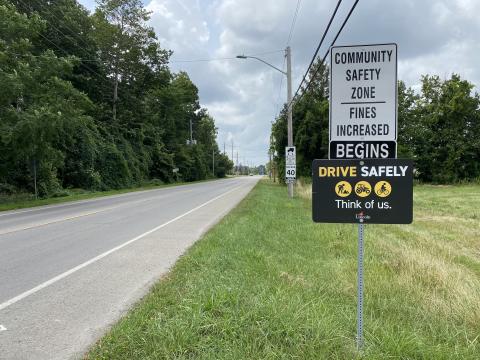
Community Safety Zone on Fourth Avenue Signage is placed along the community safety zones to alert drivers to the beginning and end of a roadway designated as a community safety zone. The rules of the road do not change within a Community Safety Zone, but fines for improper roadway use (speeding, traffic signal violations, etc.) are increased and often doubled.
The goal of a community safety zone is to modify driver behaviour to improve safety on these sections of road for all users.
The Town of Lincoln has amended the Traffic by-law to designate the following areas of roadway as Community Safety Zones:
- Connor Drive (Mountain Street to Stadelbauer Drive)
- Fourth Avenue (Nineteenth Street to Jordan Road)
- Serena Boulevard (Ontario Road to Alyssa Drive)
- Victoria Avenue (north of King Street)
- William Street (King Street to Robbie Burns Drive)
- Mountain Street (Beam Street to Edelheim Road) - Regional
- Fifteenth Street (442m south of Honsberger Road to 153m north of Red Maple Avenue (north leg))
A pedestrian crossover is a type of crossing that requires vehicles to stop and allow pedestrians to cross the road. They are typically installed on low to moderate volume roadways with speeds at or below 60km/hr.
Pedestrian crossovers have specific pavement markings and crossing signs. Pedestrian crossovers may have illuminated overhead lights / warning signs and pedestrian push buttons.
Image
At a pedestrian crossover, pedestrians have the right-of-way. Drivers and cyclists must stop behind the yield line and wait until the pedestrian has completely crossed the road and is safely on the sidewalk before proceeding.
All road users (pedestrians, motorists, cyclists) must obey pedestrian crossover rules at all times of the day and night.
Image
Motorist Responsibilities
- Be prepared to stop your vehicle for pedestrians as you approach a pedestrian crossover
- Be alert upon approach of a pedestrian crossover
- Stop your vehicle behind the yield line
- Make eye contact so the pedestrian sees you
Wait until pedestrian completely crosses the road before proceeding
Image
Pedestrian Responsibilities
- Be alert to other road users before entering a pedestrian crossover
- Indicate intention to cross
- Wait for traffic to stop
Make eye contact to ensure drivers see you
Image
Cyclist Responsibilities
- When riding with traffic, follow rules for motorists
When crossing, follow rules for pedestrians; dismount and walk your bike across
Fines and Penalties
Image
Motorists and cyclists may face a fine of $1,000.00 for disobeying the rules of a pedestrian crossover. Motorists may also face four demerit points.
In addition to these penalties, aggressive or careless drivers who put themselves and other road users (other motorists, pedestrians, cyclists) in danger may be charged with careless driving and will be subject to additional penalties and fines.
For more information regarding pedestrian safety, rules, and responsibilities at pedestrian crossings, visit the Ministry of Transportation website.
The Town installs speedhumps on areas of road that have received complaints from area residents regarding the speed, the volume of shortcutting traffic, and driver non-compliance.
Image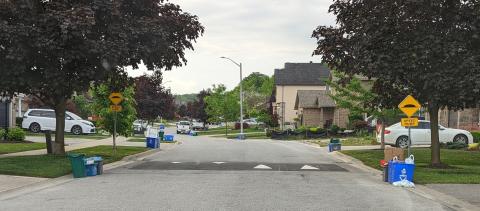
Permanent Speed Hump on Highland Park Drive Permanent speedhumps were installed at the following locations:
- Two on Connor Drive between Stadelbauer Drive and Crown Street, as well as a raised crosswalk which functions as a speed hump
- Two on Stadelbauer Drive between Connor Drive and Kayla Street
- Four on Hillside Drive
- Four on Aberdeen from King to Hillside.
The Town continues to accept input from residents regarding areas of traffic safety concern. Temporary speed humps may be installed throughout Lincoln based upon community input and concern. In these cases, further investigation into the area of concern will be completed to determine if any permanent traffic safety measures should be installed.
The Town will be installing the following temporary speed humps in 2026:
- Two on Hixon Street
- Since 2015, the Town has used Digital Speed Feedback Signs to help drivers understand how fast they are travelling.
Niagara Region is developing a Five-Year Road Safety Strategic Plan. The plan will set out the targets, policies and actions to create safer roads and reduce the number of fatal and injury collisions.
The plan's goal is to improve safety for all road users by:
- Using a data-driven approach
- Identifying and prioritizing key safety needs
- Using the five Es criteria - engineering, enforcement, education, evaluation and engagement
- Identifying shared safety needs amongst our communities
- Developing solutions that consider the needs of all road users
- Making effective safety investment decisions through coordination
- Measuring outcomes of actions taken through the plan
Niagara Region initiated a Vision Zero Road Safety Initiative in partnership with the Town of Lincoln and other local municipalities. The goal of the initiative is to:
- Reduce all traffic fatalities and severe injuries
- Increase safe, healthy and fair mobility
- Consider all active modes of transportation, such as driving, walking and cycling
- Reduce all collisions by promoting major road safety initiatives across Niagara
Approaches range from cameras, traffic calming measures, installation of active transportation infrastructure, improvement to road designs and guiderails, speed reductions, all way stops, sidewalk maintenance and partnerships with the Niagara Regional Police Service (NRPS) and the Ontario Ministry of Transportation (MTO).
A safe road network for all users is important to the Town of Lincoln and Niagara Region. Through the annual sidewalk and roadside safety programs, staff will continue to improve and enhance safety for students, pedestrians, cyclists and vehicle traffic around Town. Additionally, all project designs have a road safety lens used to consider and address roadside safety issues. Town of Lincoln staff will continue to work with Regional staff to bring forward any concerns on Regional Roads and participate in Vision Zero workshops.
In Lincoln, a red light camera has been installed at Ontario Street and South Service Road in Beamsville, and designated community safety zones are established at:
- Victoria Avenue between Frederick Avenue and King Street (a Municipal Speed Camera is also being installed at this location)
- Mountain Street between Edelheim Road and Beam Street
Niagara Region has approved a series of transportation measures, including speed limit and
signage changes, in Regional Community Safety Zones (CSZ's) as part of an ongoing effort to improve safety on the Regional road network. There are two designated CSZ's in Lincoln:- Victoria Avenue (Regional Road 24) between Frederick Avenue and King Street (Regional Road 81)
- Mountain Street (Regional Road 18) between Edelheim Road and Beam Street
For more information please refer to Niagara Region's website at https://www.niagararegion.ca/living/roads/vision-zero/community-safety-zones.aspx
Traffic Calming Requests & Concerns
Residents who have concerns regarding speeding on area roadways or other vehicle related concerns can connect with Niagara Regional Police to report.
The Niagara Regional Police Service have set up a hotline to allow citizens to provide feedback on traffic safety issues. The hotline allows the public to provide information on where traffic is dangerous, problems you're encountering on the roads, and other traffic safety complaints. This initiative serves as an additional way of reporting incidents you may have witnessed or become aware of.
To use the NRPS traffic hotline, call 905-688-4111, ext. 5555.
Traffic complaints can also be made via email, by either sending complaint to trafficcomplaints@niagarapolice.ca , or by submitting the online form.
- In order for your traffic calming request to be considered, it must first meet the following criteria:
Component Minimum Criterion - Road Type
Must be a local or a collector roadway preferably in a residential area., 2. Road Length Must be at least 150 metres, and located at least 30 metres from an intersection. 3. Road Surface Must be paved. 4. Posted Street Speed Limit Must be 50 km/h or less. 5. Volume - Local Roads: Average Annual Daily Traffic must be at least 500
- Collector Roads: Average Annual Daily Traffic must be at least 1,000
6. Road Grade Must be less than 8% and have no major horizontal curvature. 7. Public Support Petition If the first six criteria are met, the Town will survey residents to gauge support. At least 25% of the households with direct frontage or flankage onto the section of the affected section of the roadway must be in support of pursuing further traffic calming studies. Each household is represented by one signature. 8. Other No traffic calming measure has been installed in the last 5 years. 2. After the request is evaluated based on the initial criteria above, it undergoes a Traffic Calming Workflow process to consider its implementation.
Ongoing Traffic Calming Plans
On September 11 2023, Council approved that all urban residential local roads be reduced to 40km/h, and that the speed reduction becomes permanent.
Please refer to the Speak Up Lincoln page for more information:
Permanent asphalt speed humps will be constructed in Beamsville at key traffic‑calming locations:
- 3 on Cedarbrook Drive,
- 2 on Drake Avenue, and
- 2 on Connor Drive.
Each of these road segments has previously relied on temporary speed humps over the past several years to mitigate vehicle speeds and enhance neighbourhood safety.
Work has been awarded and speed humps are scheduled to be constructed in 2026.
The Town received federal funding through the Canada Community‑Building Fund (CCBF) to support this community improvement initiative.
Image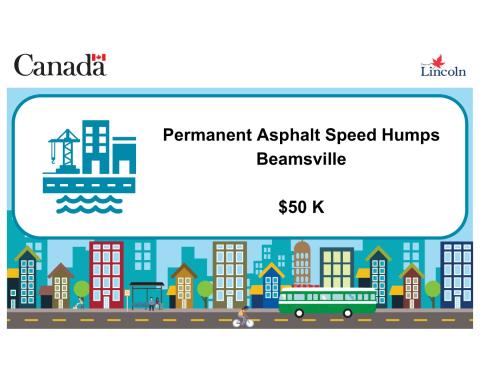
FAQs
It is important to set a speed limit that increases safety and maintains mobility.
In determining the proper speed limit, a number of factors are considered, including the width of the road, traffic volumes, pedestrian activity, existing operating speeds, collision history, intersection spacing and the number of entranceways. Speed limits are also determined in coordination with emergency services to ensure appropriate functionality and mobility is maintained for ambulance, fire and police.
Speeds are established in the Highway Traffic Act and by local and Regional by-laws. An effective speed limit is reflective of both the existing operating speed and of driver expectations.
Residents who have concerns regarding speeding on area roadways or other vehicle related concerns can connect with Niagara Regional Police to report.
The Niagara Regional Police Service have set up a hotline to allow citizens to provide feedback on traffic safety issues. The hotline allows the public to provide information on where traffic is dangerous, problems you're encountering on the roads, and other traffic safety complaints. This initiative serves as an additional way of reporting incidents you may have witnessed or become aware of.
To use the NRPS traffic hotline, call 905-688-4111, ext. 5555.
Traffic complaints can also be made via email, by either sending complaint to trafficcomplaints@niagarapolice.ca , or by submitting the online form.
Residents can also visit the Niagara Regional Police website directly for additional information.
Traffic calming is a term most commonly associated with physical features placed on a roadway to influence the speed of vehicles.
Traffic calming measures such as speed humps can have a positive influence in reducing vehicle speeds. However, there are negative effects associated with traffic calming including increased noise, increased air pollution, and diversion of traffic to adjoining streets. One of the most important factors is the support of the residents living on the street where traffic calming measures are being proposed.
Permanent speed humps and raised crosswalks are gradually sloped so that snow plow blades go over without damage to them or the pavement surface. Temporary speed humps are removed each year prior to the winter season commencement.